What Led Life to Flourish Roughly 520 Million Years Ago?

[ad_1]
Changes to the world’s oceans and the rise of certain predators may have driven diversification
/https://tf-cmsv2-smithsonianmag-media.s3.amazonaws.com/accounts/headshot/RileyBlack.png)

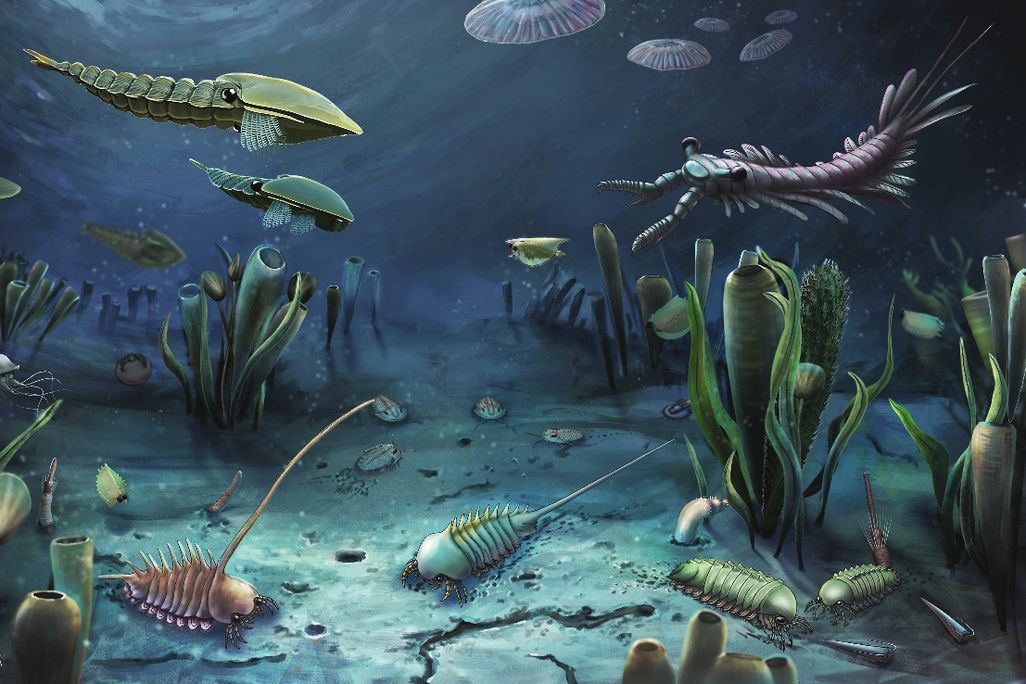
Animal life seemed to explode into a wide variety of new forms in the Cambrian period.
Sun et al. (2002). National Science Review. via Wikipedia under CC By 4.0
Sometime before 520 million years ago, animal life began to flourish as never before. The small shells, worms and even sponge-like enigmas of earlier eras suddenly unfolded into a new array of species that inhabited the world’s seas from the surface to the seafloor. The fossils of those early creatures are found in places as varied as the mountains of British Columbia, in Canada, to Australia’s southern coast. Many are so strange that paleontologists have labored for decades to work out how these organisms fit into the broader tree of life and what modern creatures they might be related to. The flowering of animal diversity is so impressive that it’s sometimes been called the Cambrian Explosion.
Paleontologists continue to debate the nature of the phenomenon. While some researchers think that a singular event led to the explosion of life, others think that the broad diversification of creatures happened over tens of millions of years, due to a variety of factors. Either way, the remains of nearshore reefs leave no doubt that animal life took on a stunning variety of new forms and behaviors during the Cambrian. Not only did worms wind through seabed sediment and shells scattered over the bottom, but there lived ancient predators that grabbed small prey with spiky appendages, many-eyed foragers that probed in the sand for tiny morsels, armored invertebrates that looked like living pincushions, and even our own slender, fishlike ancestors.
Experts have known since the 19th century that something significant happened during the Cambrian. In rock layers from the middle of the Cambrian period, paleontologists were finding a broad array of unusual animals, many of which were the early predecessors of modern organisms such as insects and squid and even of our own protovertebrate ancestors. The apparent shift required an explanation, which led experts to propose a litany of different hypotheses.
Some of the explanations for what triggered the Cambrian’s biodiversity burst had to do with abiotic factors like climate change and sea levels. Perhaps ocean currents changed to better bring nutrients to shallows where shelly and wormlike animals already lived, or maybe an influx of oxygen into the oceans introduced new biological possibilities. Then again, some researchers have proposed that the anatomy and behavior of animals themselves led to the shift. Anomalocaris is one of the most famous animals of Canada’s Burgess Shale: a predatory invertebrate with a pair of grasping appendages at the front of its head, a disclike mouth set with plates to help suck in prey, and complex eyes on stalks that could better detect a potential meal. The rise of such predators during the Cambrian, some paleontologists have suggested, would have kicked off an evolutionary arms race in which prey species would have had to develop armor, a way to escape, or perhaps even complex eyes to see the predators first.
“Ecosystems became more complex and more similar to how we know them today, with swimming animals and the first raptorial predators” that grasped at their prey, says paleontologist Gaëtan Potin, of the University of Lausanne, in Switzerland. Plankton drifted near the ocean’s surface. Predators swam in the water column. And animals burrowed into sediment around reefs made of various sponges.
No single cause can explain the entire picture, according to many experts. In fact, researchers are still working out how the known array of fossils relates to the bigger picture of Cambrian life as it truly was. The fossil record is incomplete, and sometimes what seems like a sudden appearance is really a consequence of missing information. Fossils are not preserved evenly around the planet. A rock layer full of fossils, but with few fossils in the layers below, might create the illusion of an explosion just because the older layer didn’t happen to preserve the life in the area, says paleontologist Thomas Servais, of the University of Lille, in France. The nature of the fossil record affects the patterns paleontologists propose.
The impression is of an explosion, when really the layer represents a more prolonged diversification. Most Cambrian creatures were eaten, decayed or did not make it into the fossil record, which perhaps obscures what life was like in the millions of years before the great biodiversification. Additional fossil finds are likely to fill in missing pieces of the evolutionary story. The Cambrian truly was a time when animals were evolving into many new forms and niches, but the period likely witnessed more of a long-term unfolding than the sudden instant that the word “explosion” implies.
A real understanding of the complexity of what transpired the world over, through all those millions of years, is still coming together. Earlier this summer, for example, paleontologists named a new three-eyed Cambrian predator from the Burgess Shale. The fact that a new species could show up even in a well-known and historic locality underscores how much is left to learn about the Cambrian fossil record.
What we know of Cambrian life often comes from fossils preserved among sponge-filled reefs that spread in coastal waters when most of Earth’s lands were knit together in the Southern Hemisphere and surrounded by the vast Panthalassa Ocean. Life in non-reef habitats, such as the deep or open sea, remains unknown. Still, the available evidence indicates that the Cambrian was a critical time when evolution spun off new forms of life and set the basis for ecosystems that fill the modern world.
The relatives of Anomalocaris are one indication that ecosystems’ burgeoning complexity during the Cambrian. Known as radiodonts, the broader family to which Anomalocaris belonged comprised early arthropods that came in an array of sizes with very different appendages from one another. “Within the radiodonts, some are very small, less than an inch long, and some more than six feet long,” Potin says. The size range implies that the animals needed different food sources in different amounts. In addition to predatory forms, some radiodonts sifted through sediment for small prey and others spread comblike appendages into the water column to collect plankton near the surface, where the microscopic organisms congregated.
“Multiple radiodonts living together in the same place at the same time suggests that there were enough prey items to sustain multiple populations of relatively large predators,” says University of Lausanne paleontologist Allison Daley. The spiky-armed animals fed in different ways, on prey of various behaviors and sizes, all in the same place. “To me, this speaks to a complex and diverse ecosystem already in the Cambrian,” Daley says.
An arms race alone wouldn’t explain how such animals took on so many forms, nor would a change in oxygen levels or global temperature. “It was not sudden. It was not limited to a single place or moment,” Servais says. Influences from both the living and nonliving world came together to underwrite a great flourishing. Interactions between predators and prey, as well as competition for food, certainly nudged life to evolve into a variety of forms. The ability of such organisms to build shells, exoskeletons and armor depended on minerals dissolved in the ocean. And the expansion of warm, shallow habitats in which Cambrian reefs could grow allowed much more space for these animals to live and for interactions to happen. A shift in Earth’s conditions set the stage for life to begin reshaping itself in seas with sufficient resources. Life didn’t come in with a bang. When conditions were just right, it began to blossom into the base for what we know today.
Source link Report Story


Recent Stories

3 Nights 4 Days Golden Triangle Tour radhikaholidays.com
-
Shopify Custom Apps 2026: Dev Dashboard and Legacy App Guide cartcoders.com
-
M3M Brabus Gurgaon – Premium Branded Living brabusresidence.com
-
How to Sell a Damaged Car for Cash in Brisbane kingauto.com.au
-
Luxury Apartments in Gurgaon & Delhi NCR realtyhunting.com