Stream the Beautiful Highs and Violent Lows of Albatross Life With This New 24-Hour Camera on Midway Atoll

[ad_1]
You can see the large white seabirds dancing, preening, feeding and raising young—though the live feed might show a dark side of island living, too, with potential predation from invasive mice

:focal(3075x2314:3076x2315)/https://tf-cmsv2-smithsonianmag-media.s3.amazonaws.com/filer_public/75/86/7586584f-f2d3-411e-a47d-93b1f962e8b7/a7408785.jpg)
A Laysan albatross checks on its egg.
Dan Rapp
Ecologist Wieteke Holthuijzen has loved birds since she was in grade school. The 33-year-old PhD student at the University of Tennessee, Knoxville, grew up in a family that treasures science. Her dad was a wildlife ecologist with the electrical utility Idaho Power for decades. Her mom tutors middle and high school students in math and science. The parents took their two daughters outside often and taught them how to identify plants and animals.
Holthuijzen distinctly remembers the time her dad took her at 9 years old to a bird banding station, where she got to hold a MacGillivray’s warbler—and feel its heartbeat pulsing rapidly against her hand. By high school, Holthuijzen had heard about the albatrosses of Midway Atoll National Wildlife Refuge and “Wisdom,” the oldest known banded bird in the world. She discovered a volunteer research program where students could visit the remote refuge, which is now closed to the public as part of Papahānaumokuākea Marine National Monument, the United States’ largest single protected area. An idea hatched. In college, she saved up by working at the University of Idaho Sustainability Center so she could travel to Midway and volunteer for nine months.
But when she finally flew to the atoll in the middle of the Pacific on a fall night in 2014, Holthuijzen was unprepared for the splendor that greeted her. As the plane landed, she glimpsed what looked like strange little white pillars dotting the ground, all the way up to the runway. When she got out, she realized they were Laysan albatrosses, more than a million of which nest on the islands each year. “I’d seen photos of Midway, but I just could not believe [it] … I was like, ‘Wow, they literally are carpeting the ground,’” she says. “So, it was very overwhelming, but also the greatest dream of mine was coming true.”
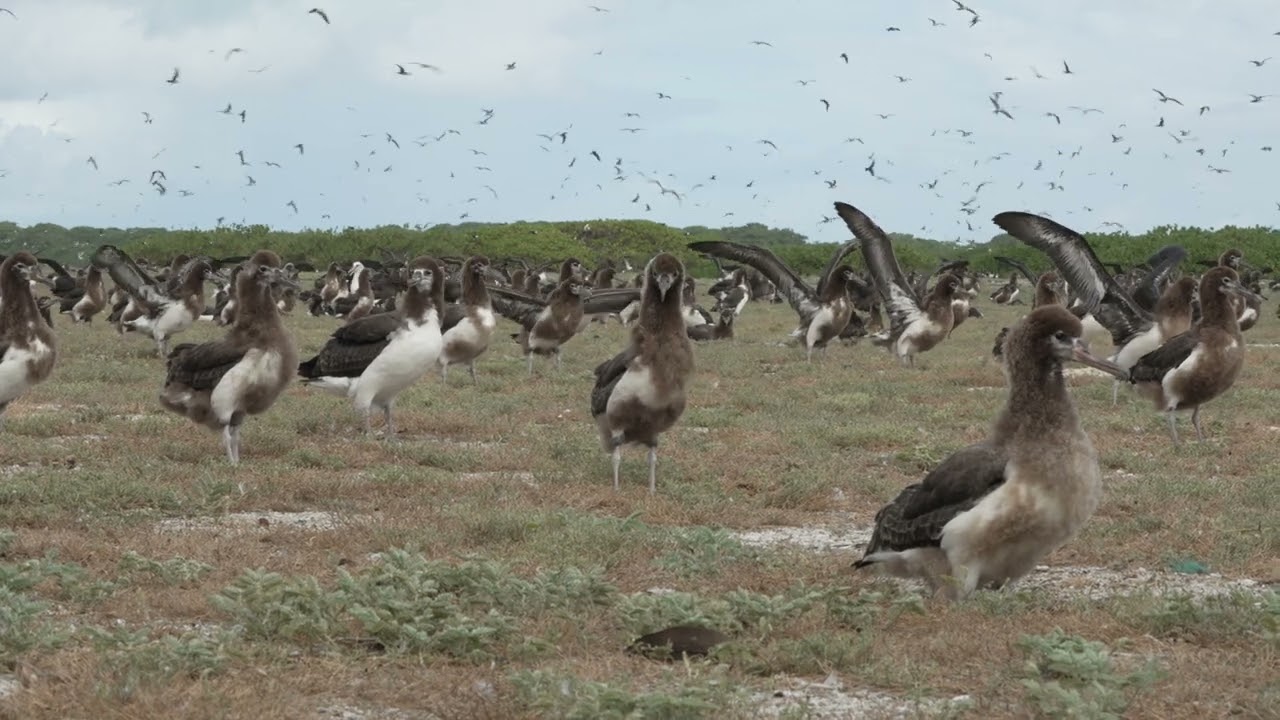
Now, everyone can get at a taste of that scale, as the nonprofit Friends of Midway Atoll has set up a wildlife camera streaming 24-hour live views from Sand Island, one of the atoll’s three islands. The camera went public on October 29, and soon, hundreds of the birds showed up. Laysan albatrosses, mostly white birds with smoky shading on their faces and six-foot-plus wingspans, dominate the frame. Viewers can watch and listen to a throng of the birds dancing, nesting and calling out with moans, whines and snaps of their bills.
“When you’ve never been to a place like Midway, it’s hard to imagine,” says Friends of Midway Atoll board president Wayne Sentman, a former U.S. Fish and Wildlife Service researcher. “There’s a million and a half seabirds? That sounds like a really scary Hitchcock movie.” But to him, being surrounded by albatrosses is much more pleasant: “Imagine if there were 1.5 million puppies running around, because that’s kind of what it feels like.”
Midway Atoll NWR Wildlife Live Camera

Friends of Midway Atoll members dreamed of setting up a camera for more than 20 years, but the idea really gained steam after 2012, when public visitation to the atoll ended. Low-cost and high-speed satellite internet helped make the camera a reality, says Sentman, along with the technological expertise of U.S. Fish and Wildlife Service volunteer Dan Rapp, who set up the device and maintains it. The feed was not created as a monitoring tool for the U.S. Fish and Wildlife Service and is instead meant for public viewing.
“This is a huge step to really bringing the refuge to the public and giving them a sense, not only of ownership, but pride,” says Holthuijzen, “being able to be like, ‘Yeah, this is American soil, and we are protecting millions of birds in this really unique place.’”
Including the large, charismatic Laysan albatrosses, or moli in Hawaiian, roughly two million birds of about 20 species nest on Midway, which is known as Kuaihelani in Hawaiian. While tuning in, viewers might also glimpse neighboring black-footed albatrosses, ethereal blue-billed white-terns, burrowing bonin petrels and squawking red-tailed tropicbirds, among other species.
Fun fact: The extraordinary flight of an albatross
Albatrosses might spend years flying above the ocean without visiting land, though they’ll touch down on the water’s surface to briefly feed. And they stay aloft almost without flapping their wings, taking advantage of updrafts with a technique called dynamic soaring.
Marine biologist Lindsay Young has visited Midway Atoll ten times, she would guess, and has spent 23 years studying albatrosses. The current vice president of research for National Geographic’s Pristine Seas initiative, Young became intrigued by the large birds when she took a Semester at Sea at 20 years old—attending college classes while aboard an oceangoing vessel. She saw albatrosses following her ship from off the west coast of Canada across the Pacific to Japan, and she was surprised to find out they nested on remote islands so far away.
The sheer number of Laysan albatrosses at Midway, where roughly 70 percent of the global population nests, is staggering, Young says—and it makes their lives much different from those of birds in smaller colonies. “It’s almost like the difference between being downtown and in the suburbs,” she says. “When they’re really, really crowded, there’s a lot more interactions between the birds, both aggressive and non-aggressive.”
Because the birds spend time on both land and sea, Young notes, they are vulnerable to threats from both environments, which viewers of the camera feed might witness. Watchers could see a bird with oil on its breast from floating near a shipwreck, a predatory mouse feeding on the head or neck of a live nesting bird, or an adult albatross attacking another bird’s chick.
“Seabird colonies are big, messy, dynamic places,” says Young. “There’s a lot of behavior and noise going on, and there are a lot of really special moments you can watch. There’s also a lot of death and a lot of violence.”
:focal(2768x2082:2769x2083)/https://tf-cmsv2-smithsonianmag-media.s3.amazonaws.com/filer_public/8a/8a/8a8af4f5-78a3-4051-a9bc-7681839ad3c0/a7409332.jpg)
:focal(3490x1978:3491x1979)/https://tf-cmsv2-smithsonianmag-media.s3.amazonaws.com/filer_public/e4/c4/e4c4959b-b196-4a14-b00d-67f50ee3e4df/a7409908.jpg)
:focal(2675x2012:2676x2013)/https://tf-cmsv2-smithsonianmag-media.s3.amazonaws.com/filer_public/08/da/08da12dd-1435-4738-85c8-3b64ab8fd09d/a7401748.jpg)
One thing bird fans likely won’t see is Wisdom, the popular 75-year-old mother of as many as 30 chicks. Sentman says this famed Laysan albatross nests in an area that is not ideal for a camera, and her presence is already well documented by scientists.
But livestream regulars will be able to watch plenty of captivating behavior from other albatrosses throughout the year as the birds find mates, build nests and ultimately hatch chicks.
After flying around the open ocean for months or years, Laysan albatrosses begin returning to Midway around mid-October. Established pairs of the birds—which almost always return to the same mates—dance by bobbing their heads, placing their bills under their wings, facing each other while clattering their beaks, and pointing their faces skyward. Then, they mate.
Albatrosses perform a mating dance

The female bird constructs the nest by forming a depression in the ground with her feet, then placing twigs, sand and leaves around it. Shifts in the weather can play a role in this process. “After it rains and the ground is kind of wet, there’s this frantic nest-building that will happen,” Holthuijzen says. “You’ll see the birds use their bills to pull in soil toward their nest cup and build almost like a fortress around them.”
Rain can also bring “amazing” behaviors, she adds. Albatrosses will “tip up their heads and snap water droplets as they come down.”
Young albatrosses in the rain
From November to around Christmas, the birds lay their eggs and will often perform what is Young’s and Holthuijzen’s favorite behavior to watch: allopreening, or social grooming, among mated pairs and even albatrosses that seem to be strangers. An albatross may walk up to a lone bird on a nest and begin grooming its head or neck with its beak. The receiving albatross may turn its head, like a dog or cat getting a scratch, indicating the contact feels good.
A black-footed albatross turns its head to the side to allow another adult to groom it in a behavior known as allopreening. Dan Rapp/https://tf-cmsv2-smithsonianmag-media.s3.amazonaws.com/filer_public/d9/f8/d9f84820-d4f5-4b2d-a5ae-8ce778263015/a7403736.jpg)
One of the grisliest events involving the birds may also take place during incubation. While a parent sits on an egg, one of the atoll’s invasive mice may crawl onto the bird and feed on the back of its neck or top of its head, causing injury. “These are pretty big, bloody, open wounds,” says Holthuijzen.
House mice were introduced to the island during World War II but first documented feeding on the birds in 2015. Hundreds of the birds have since died from the predation. The albatrosses don’t fend off mice, because they’ve evolved on islands without predators and haven’t built up defenses. Sometimes, however, the attacks will prompt the birds to abandon their nests. Conservationists tried and failed to rid the island of mice using rodenticide in 2023, and Holthuijzen is studying whether the mammals have developed rodenticide resistance. If viewers glimpse the mice on the webcam, says Sentman, they should take away that, once introduced, invasive species can cause unexpected problems and cost millions of dollars to wipe out.
Amid the incubating in January and February, the island also turns into a kind of singles bar. Young birds that haven’t yet found their mates return to the island and dance, often in large groups. “It’s exactly the same thing if you go to a dance club with humans,” says Young. “You might have one person you’re kind of dancing with, but really there’s a whole bunch of you all around, and it’s how they’re locating their partner.”
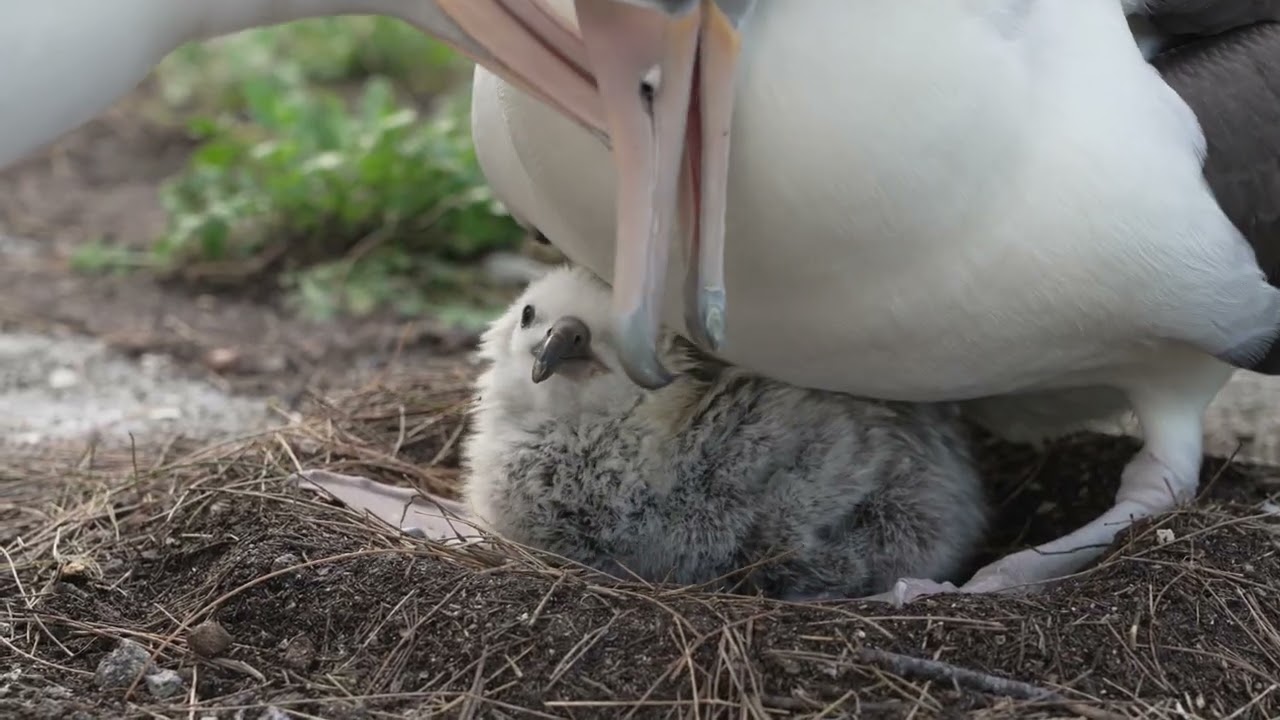
As that ruckus goes on around them, the neighboring adults may start softly talking to their chicks through the eggshells. Once ready to hatch, albatross chicks break through the membrane inside the egg and begin breathing from a small pocket of air within—and it can take them four days to crack the shell. “The adults are kind of giving them pep talks and letting them know to come out,” says Young. “They recognize who their parents are through the vocalization.”
A Laysan albatross parent will softly talk to a chick in the egg to encourage the youngster to break through the shell. Dan Rapp/https://tf-cmsv2-smithsonianmag-media.s3.amazonaws.com/filer_public/d9/19/d9197a0d-1b39-49b2-b0b7-9f500c1cb30c/a7408656.jpg)
By February, chicks are hatching, and at least one parent will always be with them. After a few weeks, though, both parents will take off to feed. They may fly as far as 7,000 miles round-trip, Young says, to gather a slurry of squid and fish for their chicks. Once alone again, the growing hatchlings will kick debris out of their nests and stretch their wings. “Watching these tiny little bowling pins of fluff start to imitate their parent behaviors in March and April is pretty fun,” says Young.
Albatross parents and chick
Raising a chick isn’t easy. Parents may unwittingly transfer plastic picked up at sea into their hatchlings’ mouths. Sometimes, adult black-footed albatrosses, or kaʻupu in Hawaiian, will return from sea to feed their chicks and aggressively attack neighboring chicks. They may grab the youngsters by the neck with their beaks and shake angrily. Researchers don’t know exactly why this happens, but they think it may somehow trigger the chick’s parent to release food to the aggressive adult’s own chick. As the weather warms into April, chicks may die from dehydration, from starvation or for other reasons.
By May, the colony’s remaining chicks lose their down, developing funny “hairstyles” with the fluff that’s left. Some will sport mullets, mohawks or goatees. Come June and July, the youngsters look a lot like their parents and are jumping up and flapping their wings—and in no time, they’re flying off. If they survive, the young birds will fly over the Pacific for years before returning to where they were born to find mates and begin their own families.
Chicks are initially covered in downy fluff. Dan Rapp/https://tf-cmsv2-smithsonianmag-media.s3.amazonaws.com/filer_public/27/2d/272d67ac-7f9c-4015-a784-9dd1db1f4d5d/a7405890.jpg)
The chicks sport different “hairdos” as they lose their down later in the year. Dan Rapp/https://tf-cmsv2-smithsonianmag-media.s3.amazonaws.com/filer_public/bf/eb/bfebf7c6-af02-4c54-b28e-95e1be9793a8/a7407260.jpg)
A young Laysan albatross spreads its wings as the wind picks up. Soon, it will take to the skies. Dan Rapp/https://tf-cmsv2-smithsonianmag-media.s3.amazonaws.com/filer_public/f5/8d/f58ddc2f-3efc-47fc-b0c8-82013f260cf9/a7403005.jpg)
Albatrosses are top marine predators, and how they fare may offer clues into how the Pacific is changing, the researchers say. The birds benefit the ocean and islands in big ways, fertilizing the land with guano, regurgitations and even their eventual dead, decaying bodies—all things you might see on the live feed.
Scientists have studied the birds pretty comprehensively since the 1940s, Young notes, but that’s not to say you won’t see something unexpected when you watch. Young has looked at almost every aspect of albatross biology throughout her career. She has researched their disease prevalence, examined their genetics, tracked them at sea, measured conservation outcomes and even closely studied how they turn their eggs. But every time she thinks she knows everything there is to know about these charismatic seabirds, they surprise her with something new. “It gets to the ethos that we as humans have, of, ‘We must’ve done it all,’” she says. “And the answer is: We haven’t even scratched the surface.”
Source link Report Story


Recent Stories

3 Nights 4 Days Golden Triangle Tour radhikaholidays.com
-
Shopify Custom Apps 2026: Dev Dashboard and Legacy App Guide cartcoders.com
-
M3M Brabus Gurgaon – Premium Branded Living brabusresidence.com
-
How to Sell a Damaged Car for Cash in Brisbane kingauto.com.au
-
Luxury Apartments in Gurgaon & Delhi NCR realtyhunting.com